
 To reduce the impact of our society on global warming and the natural environment we are aiming to switch to the use of renewable energy sources. Currently, society is still dependent on fossil fuels both for energy (coal, natural gas, crude oil) but also for the production of synthetic chemicals (plastics, lubricants etc). One of the largest challenges for the energy transition is the storage of energy. Batteries form a part of the solution. Here at the magnetic resonance research center we investigate the next generation of battery materials. Using 7Li NMR we can for instance look at the mobility of lithium ions in solid electrolytes. We also study the effect of various treatments such as doping of the materials on its ion conductivity and relate that to the structural changes we can detect using NMR on a variety of nuclei. In the internship you can learn how to use a research grade NMR spectrometer and we can tailor your internship towards a more theoretical approach or a more engineering type of project where you can test battery assemblies. If you want to know more, visit our website or even better, talk to us, there always new and challenging projects running.
keywords:
Electrical Impedance Spectroscopy
NMR
solid state NMR
voltametry
To reduce the impact of our society on global warming and the natural environment we are aiming to switch to the use of renewable energy sources. Currently, society is still dependent on fossil fuels both for energy (coal, natural gas, crude oil) but also for the production of synthetic chemicals (plastics, lubricants etc). One of the largest challenges for the energy transition is the storage of energy. Batteries form a part of the solution. Here at the magnetic resonance research center we investigate the next generation of battery materials. Using 7Li NMR we can for instance look at the mobility of lithium ions in solid electrolytes. We also study the effect of various treatments such as doping of the materials on its ion conductivity and relate that to the structural changes we can detect using NMR on a variety of nuclei. In the internship you can learn how to use a research grade NMR spectrometer and we can tailor your internship towards a more theoretical approach or a more engineering type of project where you can test battery assemblies. If you want to know more, visit our website or even better, talk to us, there always new and challenging projects running.
keywords:
Electrical Impedance Spectroscopy
NMR
solid state NMR
voltametry
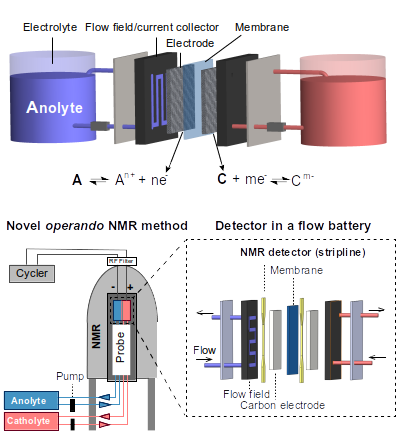
Large-scale energy storage is becoming increasingly critical to balance the intermittency between renewable energy production and consumption. Redox Flow Batteries (RFBs), based on inexpensive and sustainable redox-active materials, are promising storage technologies. A RFB consists of two tanks of redox-active electrolytes, one catholyte and one anolyte, and its capacity can be scaled up just by increasing the volume of the tanks. The electrolytes flow through an electrochemical cell where redox reactions happen. Due to this design, one of the distinct features of RFBs is the decoupling of their energy storage and power generation, which provides unique opportunities for in situ monitoring. We have developed in situ NMR metrologies to probe the electrolyte in the flow path or in the battery cell (Nature 2020, 579, 224).
Internship projects are available on various aspects of the operando NMR studies of flow batteries, and electrochemical ammonia synthesis or carbon dioxide reduction. These projects are interdisciplinary in nature. We work with colleagues in the Netherlands and across the globe on the following research topics:
Project 1. MRI of flow in advanced redox flow battery electrodes.
Project 2. Synthesizing and understanding redox-active organic molecules for redox flow batteries.
Project 3. Developing coupled benchtop NMR and EPR methods for studying redox flow batteries.
Project 4. Machine-learning analysis and optimization of redox flow batteries.
Project 5. Understanding Li nitridation for electrochemical ammonia synthesis by operando NMR
Project 6. Machine-learning force field calculation of reaction intermediates for Li-mediated ammonia synthesis